
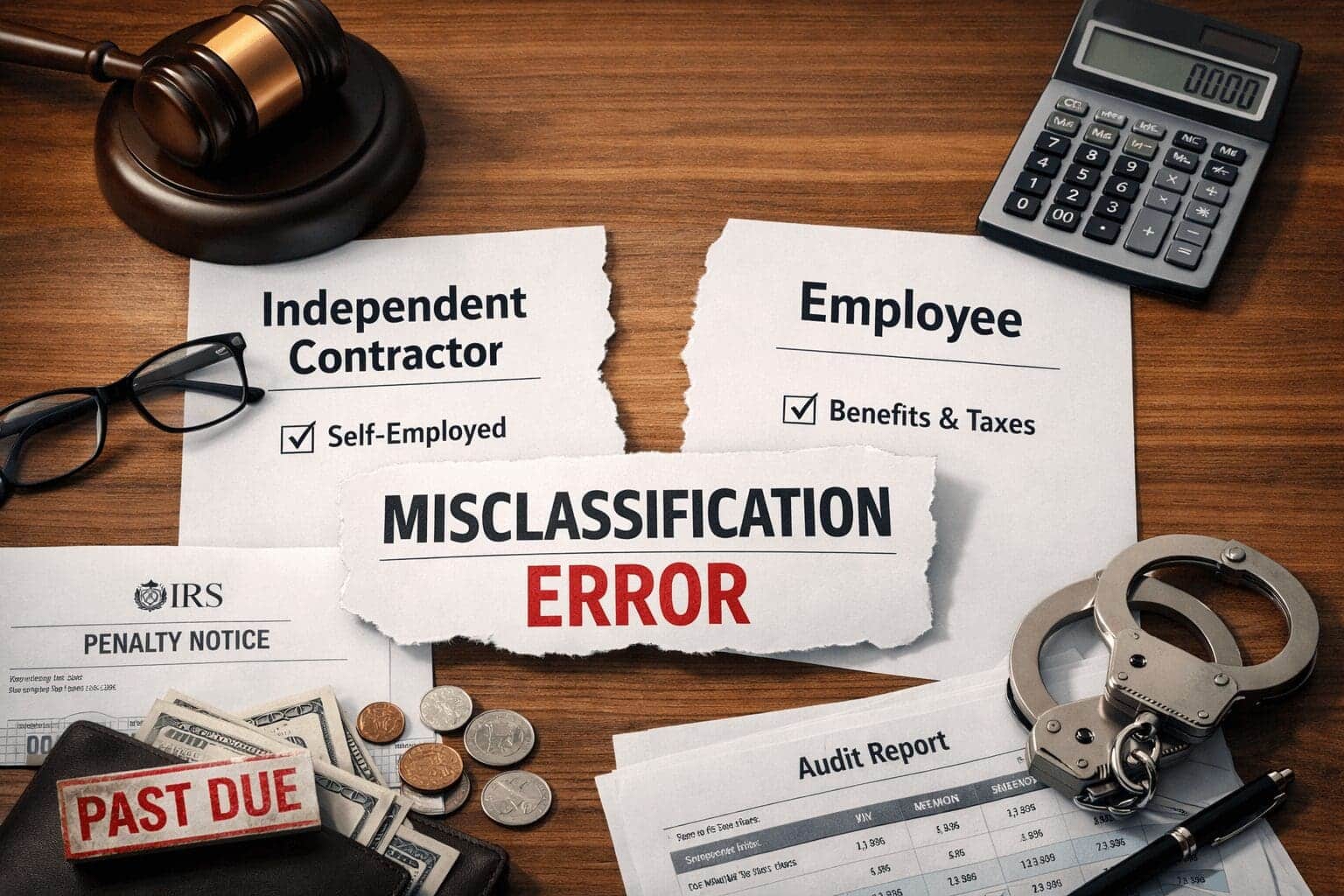
The Costly Mistake of “Contractor” Misclassification
Why Getting Worker Status Wrong Can Put Your Practice at Risk
In healthcare and small-business settings alike, it may seem harmless—and even financially savvy—to classify workers as independent contractors rather than employees. After all, contractors don’t require benefits, payroll taxes, or overtime calculations. But when the relationship functions like traditional employment, misclassification becomes more than a simple paperwork error. It transforms into a compliance risk with real legal and financial consequences.
Case Study: When Per-Diem Nurses Were Labeled as Contractors
A rural medical practice classified several per-diem nurses as 1099 contractors (IRS filing status) to reduce employer taxes and employee benefits costs, and to simplify scheduling. The problem? To satisfy the IRS that a nurse is an independent contractor, the nurse must have autonomy and contractual control over what, how, and when work will be done.
In this case, the nurses’ working relationship looked nothing like an independent contractor
arrangement:
- The nurses received daily schedules created by management.
- The practice dictated how care tasks were performed.
- The clinic provided equipment, supplies, and workflows in full.
- The nurses functioned as an integrated part of clinical operations.
This put the practice at risk for:
- Owed overtime wages
- Back taxes and the employer’s share of FICA
- Penalties from the IRS and state workforce agencies
- Potential wage claims from the workers
- Legal exposure under federal and state labor laws
Why Was It a Red Flag Under the Fair Labor Standards Act (FLSA) and IRS Rules?
The IRS and Department of Labor (DOL) both use variations of a control test to determine worker classification. But the key question is: Does the organization control what is done and how it is done?
For healthcare roles—especially nurses—this becomes especially tricky because patient care must follow standardized protocols, clinical tasks are typically directed by licensed providers, and documentation, quality, and scope-of-practice requirements are tightly regulated. If the organization controls the schedule, method, tools, and integration of work, it’s almost impossible to justify a 1099 status.
How To Fix It
Once a misclassification is identified, quick corrective action is critical. A defensible response includes:
- Reassess worker status using DOL and IRS criteria
Review the role against the economic reality test, behavioral and financial control factors, and the type of relationship. - Reclassify staff correctly going forward
This may include moving individuals into PRN, part-time, or full-time employee categories depending on organizational needs. - Provide retroactive pay or benefits if required
This may include:
- Overtime corrections
- Back taxes
- Employer FICA contributions
- Access to retirement or health benefits (when applicable)
- State-specific penalties
- Standardize job descriptions and contracts, and eliminate ambiguity by establishing:
- Clear employee vs contractor definitions
- Consistent onboarding and contracting processes
- Standardized scopes of work
- Updated HR policies and classification guidelines
Compliance Takeaway
Misclassification might look like a cost-saver today, but in reality, it’s a high-risk compliance gamble. Organizations pay far more in penalties, back wages, legal fees, and reputational damage than they ever save by avoiding benefits or payroll obligations. Every healthcare role touches patients, so documentation and accurate classification are not optional.
Getting worker classification right protects:
- The organization
- The individual
- The workforce
- Financial integrity and Compliance credibility